You can’t become a shaman in 30 days
Why a 30-day course can’t teach what holding a ceremony asks of someone
Last updated 28 October 2026.
In case you wondered, there is no Ayahuasca Shaman Academy here, no 30-day course and no printable certificate. If you came here from the page advertising one, that page is a parody. What it parodies is real, though: courses that offer the title of shaman to anyone with a free month and a credit card. This page is about why that doesn’t work, can’t work and shouldn’t work.
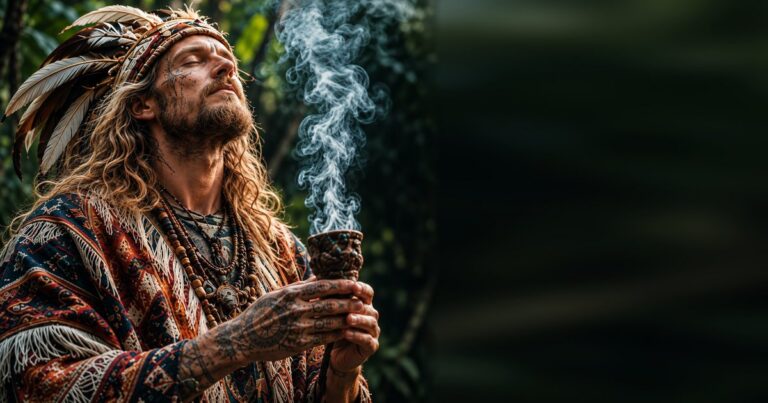
Why the parody
Search for ayahuasca facilitator training, and you will find weekend modules, online certificates and ‘shamanic practitioner’ diplomas. The one who pays gets a certificate, a stamp and often an illusion, and the people who later sit with them may get someone less experienced than a safe ceremony requires. Holding a ceremony may look easy. It isn’t.
Even when all goes smoothly, the ayahuasca does the work, and nobody freaks out, the facilitator has to be fully present every minute and hold the space of the whole room: knowing where everyone is, not only physically but in their process. That asks a lot, and without experience or a good team, it is hard. The real test is what happens when the shit hits the fan. And when the facilitator can’t contain the group at that moment, the shit will be all over the place, and beyond. It is a responsibility for others that shouldn’t be taken lightly.
What the word ‘shaman’ hides
‘Shaman’ comes from Evenki, a language of Siberia, and reached European languages through Russian. Outsiders later applied it to healers and ritual specialists across the world. The traditions that work with ayahuasca have their own words, and they differ. Among the Shipibo-Conibo of the Peruvian Amazon, a specialist may be called onanya. In mestizo Amazonian practice you will hear curandero or vegetalista. In the Brazilian ayahuasca churches, such as Santo Daime and the União do Vegetal, the brew is taken in formal religious rituals led by people recognised within the church over many years.
Some practitioners do use ‘shaman’ or chamán today, often for outsiders’ benefit. So the word alone proves nothing either way. What matters is what stands behind it.
How people actually learn this work
The routes differ by tradition, but they share a few things.
Time. Learning is measured in years, not weeks. A future facilitator gains experience over many hours of sitting and drinking in ceremony themselves, processing what needs to be processed.
Discipline. In Amazonian traditions, the core of an apprenticeship is the dieta: periods of seclusion, restricted food and abstinence while working with particular plants, repeated over years under a teacher. In the Brazilian churches, it means years of participation in the rituals before taking on any responsibility for them.
A teacher and a lineage. Knowledge passes from person to person: the songs, the preparation of the brew, and the judgement of when to step in and when to leave someone be. That judgement can’t be downloaded.
Recognition. Authority is rarely self-declared. Depending on the tradition, it comes from a teacher, a church or, in practitioners’ own account, the plants themselves, and it is confirmed over time by the people who watch how someone handles fear, power, money and trust.
None of this guarantees a good facilitator. But when none of it is there, that is a reason to ask more questions.
What holding a ceremony asks of someone
Beyond the ritual itself, the person leading a ceremony carries responsibilities no certificate covers:
- Screening. Knowing which medications and conditions make ayahuasca dangerous, asking about them properly, and saying no when needed. Good screening reduces risk; it does not remove it.
- The brew. Knowing what is in it and where it came from, and being open about that.
- The difficult hours. Staying steady when someone is frightened, confused or overwhelmed, and recognising when distress becomes a physical or psychiatric emergency.
- Boundaries. People in ceremony are suggestible and open. A facilitator holds real power over them, and the work depends on never using it for themselves.
- Afterwards. Being available when someone needs help making sense of what happened, sometimes weeks later.
A 30-day course can describe these. It cannot give someone the experience to carry them. And it shouldn’t pretend to: power over people who are open and suggestible is something others should have seen a facilitator earn, over years.
What a responsible facilitator looks like
Measured against all of this, a few markers separate serious practice from a bought title:
- They can say how long they have worked, with whom they learned, and who would vouch for them.
- They screen carefully for medications and health conditions, and turn people away when necessary.
- They are open about exactly what is in the brew.
- They don’t promise healing, visions or specific results.
- They offer support afterwards.
- They are known through people, not only through reviews.
Our page on Safety & care covers these in more depth. For the traditions themselves, see Ceremonial contexts.
And if part of you wants to do this work
Perhaps you clicked because you would like to do this work one day. That is not a foolish wish. In every tradition described here, though, the road is long, and the people who walk it often spend many years as participants and learners before they earn the trust and skills to lead.
For therapists who want to work with psychedelics professionally, there is serious education. One we can wholeheartedly vouch for is the OPEN Foundation’s ADEPT training, a two-year programme for licensed mental health professionals.
And if you are simply wondering what ayahuasca involves, and whether it is something to consider at all, our self-check is a calm place to start thinking it through.
To finish: we trust you understand that we don’t offer a 30-day shamanic course.
Be well and stay safe.